JMCI is a peer-reviewed scholarly journal dedicated to advancing theoretically grounded and evidence-based research at the intersection of mathematical cognition and instructional practice.
The journal investigates how mathematical understanding develops through reasoning, representation, interaction, and instructional mediation. JMCI welcomes empirical, theoretical, and design-oriented studies that contribute meaningful explanations of mathematical thinking, learning, and instruction across diverse educational contexts.
|
01
Mathematical Cognition
Mathematical reasoning, thinking, representation, conceptual understanding, and cognitive processes.
|
02
Instructional Practice
Instructional design, pedagogical reasoning, classroom interaction, mediation, and learning environments.
|
03
Mathematical Understanding
How learners construct, communicate, refine, and apply mathematical knowledge.
|
|
04
Representation & Interaction
Representational systems, communication, dialogue, collaboration, and mathematical activity.
|
05
Technology & Learning
Digital environments, technological mediation, and emerging approaches to mathematics learning.
|
06
Inclusive Mathematics Education
Cognitive diversity, accessibility, equity, inclusion, and participation in mathematical learning.
|
|
Publisher
Department of Mathematics Education
|
Frequency
Quarterly
|
Review
Double-Blind Peer Review
|
Access
Open Access
|
Current Issue
Vol. 1 No. 1 (2026): April 2026
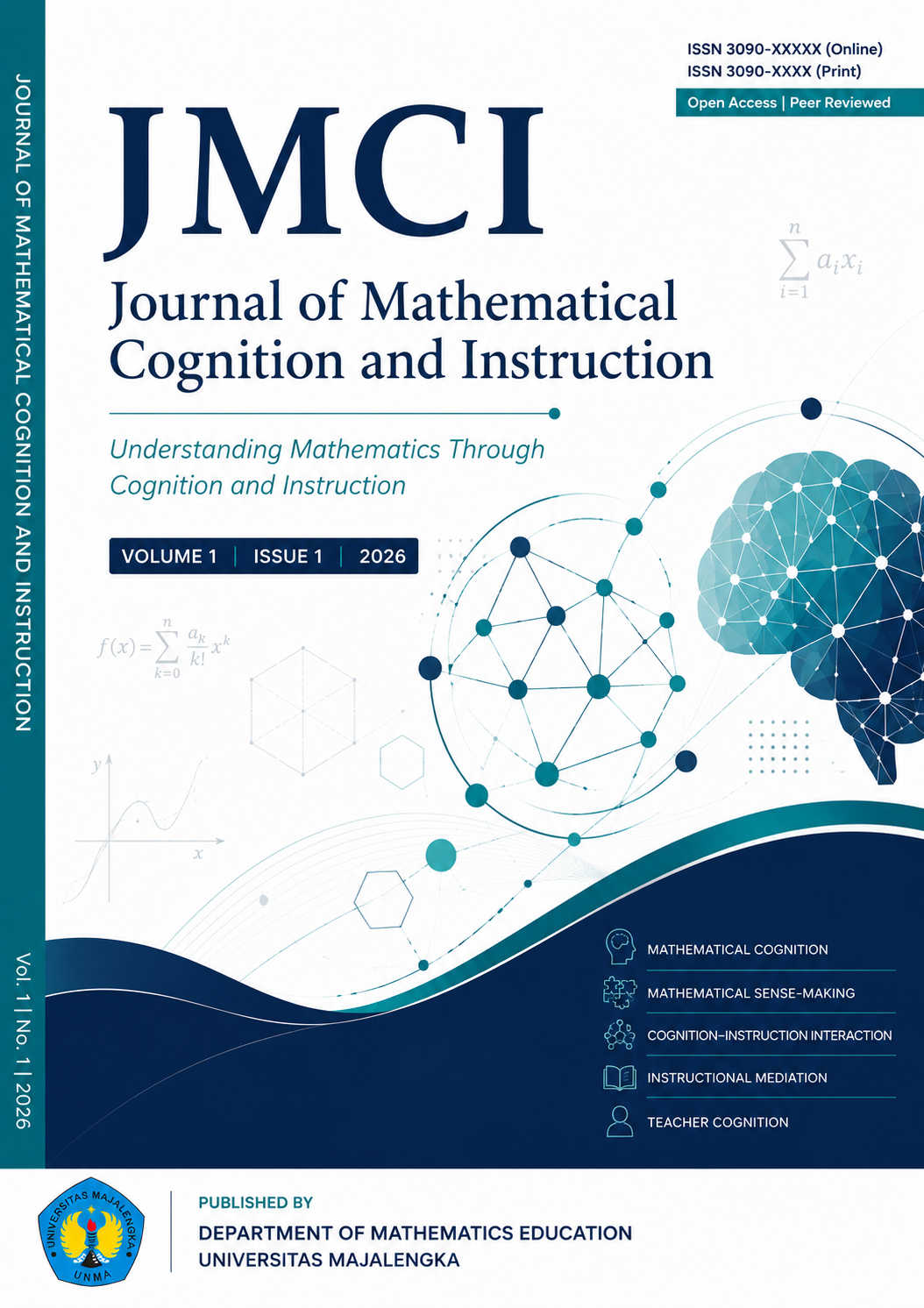
This issue brings together scholarly contributions examining mathematical learning through the interconnected perspectives of cognition, reasoning, representation, and instruction. The articles address diverse aspects of mathematics education and provide theoretically informed and empirically grounded insights into how learners develop mathematical understanding.
The contributions reflect a commitment to rigorous, relevant, and meaningful research that connects mathematical cognition with instructional practice. Together, they offer perspectives that may inform mathematics education research, teaching, learning, and the design of more responsive instructional environments.
Published: 2026-04-12