Performance Evaluation Of An Unsignalized Four-Leg Intersection And Traffic Signal Planning Using Ptv Vissim: A Case Study Of Panjalin Intersection, Majalengka
DOI:
https://doi.org/10.31949/j-ensitec.v12i02.18745Abstract
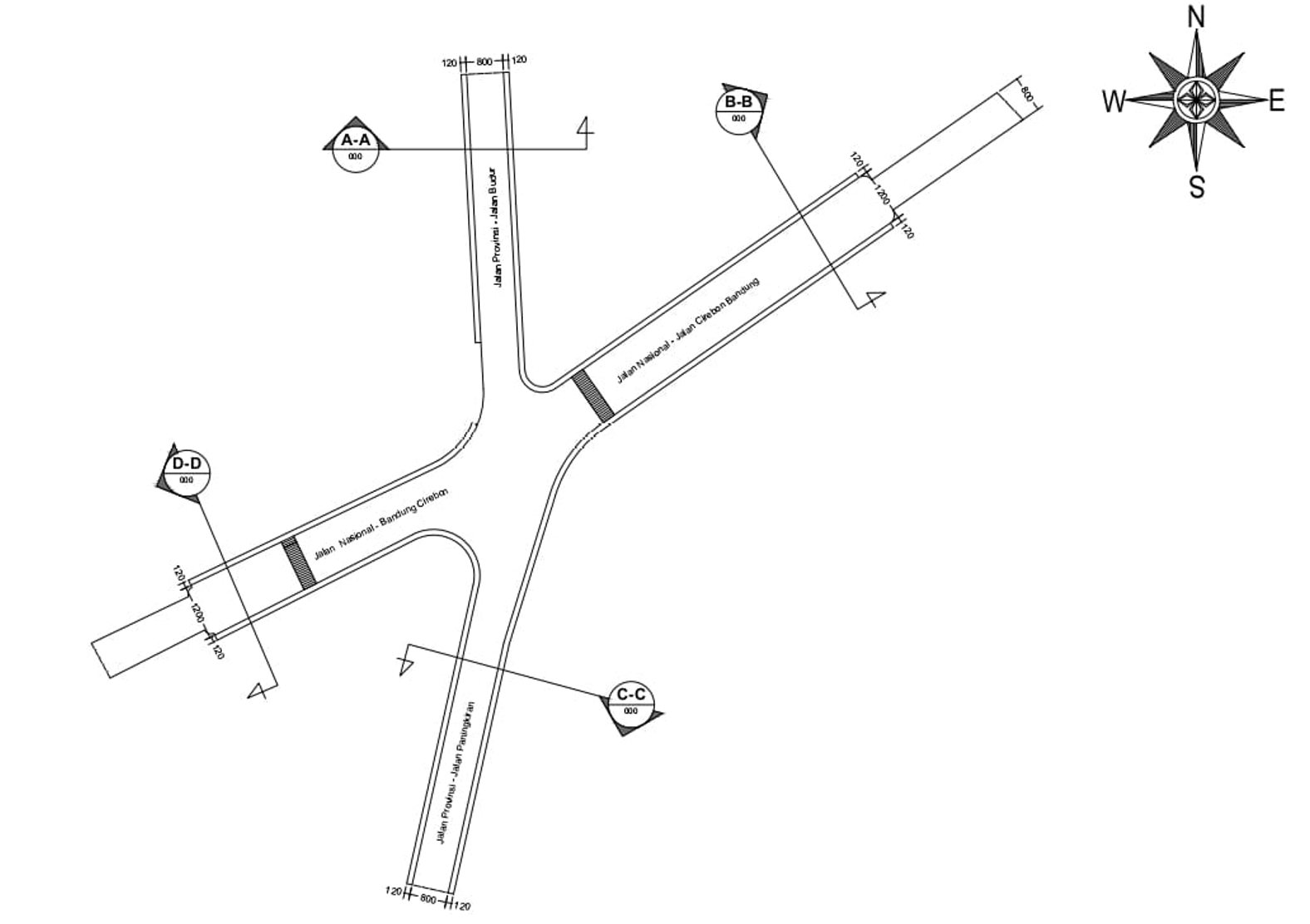
Panjalin Intersection is a strategic four-leg junction connecting the Cirebon–Bandung national road with the Budur–Paningkiran provincial road in Majalengka Regency. Its unsignalized operation, intensive roadside commercial activity, and increasing peak-hour demand create recurring conflicts and unstable traffic movements. This study evaluates the existing intersection and develops a two-phase traffic-signal alternative using the 2023 Indonesian Road Capacity Guidelines (PKJI 2023) and PTV Vissim microscopic simulation. Primary data consisted of intersection geometry, seven-day classified turning-movement counts, vehicle speeds, and roadside-environment observations. Secondary data included population and road-status information. Under the existing condition, total demand reached 2,604 passenger-car units per hour, while the calculated capacity was 2,747.84 passenger-car units per hour. The resulting degree of saturation was 0.947, exceeding the PKJI design criterion of 0.85; the average intersection delay was 16.946 s/pcu and the upper queue-probability estimate was 71.63%. A two-phase signal plan with a 42-s cycle, 15.38-s green time for Phase 1, and 16.62-s green time for Phase 2 reduced approach degrees of saturation to 0.610–0.681, with an average of 0.649 and an average delay of 14.679 s/pcu. The Vissim scenario comparison also indicated reductions in average queue, maximum queue, stopped vehicles, and average travel time by 46.4%, 44.7%, 51.2%, and 21.7%, respectively. The combined analytical and simulation results show that installing a coordinated two-phase traffic signal is a technically reasonable short-term treatment, provided that signal timing, side friction, and queue development are monitored after implementation.
Keywords:
Intersection Performance, PTV Vissim,, PKJI 2023,, Traffic Signal,, Unsignalized Intersection,Downloads
References
[1] Directorate General of Highways, Ministry of Public Works and Housing, Pedoman Kapasitas Jalan Indonesia (PKJI) 2023, No. 09/P/BM/2023. Jakarta, Indonesia, 2023.
[2] Government of the Republic of Indonesia, Government Regulation No. 79 of 2013 concerning Road Traffic and Transportation Networks. Jakarta, Indonesia, 2013.
[3] PTV Planung Transport Verkehr GmbH, “PTV Vissim: Multimodal microscopic traffic simulation software,” Karlsruhe, Germany, 2025.
[4] A. Mufhidin and N. A. D. Chaniago, “Performance analysis of unsignalized intersections and road sections using Vissim software,” Jurnal Pensil: Pendidikan Teknik Sipil, vol. 12, no. 2, pp. 160–177, 2023, doi: 10.21009/jpensil.v12i2.34770.
[5] S. Hadi and Khairurrasyid, “Performance analysis of unsignalized intersection using PTV VISSIM software modeling (case study of Sakra 4-way intersection, East Lombok),” IOP Conference Series: Earth and Environmental Science, vol. 1321, no. 1, art. 012027, 2024, doi: 10.1088/1755-1315/1321/1/012027.
[6] H. A. Putri, S. N. Kadarini, and E. T. Mukti, “Analysis of signalized intersection using MKJI 1997, PKJI 2023, and PTV VISSIM: Case study in Pontianak,” Jurnal Teknik Sipil, vol. 25, no. 3, 2025, doi: 10.26418/jts.v25i3.88796.
[7] Y. A. Jalus, Ircham, and H. P. Astutik, “Analisis kinerja simpang bersinyal menggunakan software PTV Vissim (studi kasus Jalan PGRI II Sonosewu, Kabupaten Bantul, Daerah Istimewa Yogyakarta),” 5th CEEDRIMS 2024, vol. 5, no. 2, pp. 225–234, 2024.
[8] A. Y. E. Ado, A. T. Handayani, and H. P. Astutik, “Analysis of signalized intersection performance using PTV VISSIM software: Case study of Proliman Intersection, Prambanan,” Spektrum Sipil, vol. 11, no. 2, pp. 97–108, 2024, doi: 10.29303/spektrum.v11i2.361.
[9] A. G. Theodora, Najid, H. R. S. Angkat, and L. S. A. D. R. Sianturi, “Analisis kinerja simpang bersinyal menggunakan PKJI 2023 dan mikrosimulasi PTV Vissim pada Simpang Empat Muncul, Serpong,” Jurnal Mitra Teknik Sipil, vol. 8, no. 4, pp. 1241–1248, 2025.
[10] K. S. W. Pedo, E. N. B. Seran, and K. R. Bela, “Manajemen dan rekayasa lalu lintas simpang menggunakan simulasi PTV Vissim 9.0,” Jurnal Aplikasi Teknik Sipil, vol. 23, no. 3, 2025, doi: 10.12962/j2579-891X.v23i3.20596.
[11] PTV Planung Transport Verkehr GmbH, “PTV Vissim Student Version,” Karlsruhe, Germany, 2025.
[12] I. T. Muchlisin and W. Widodo, “Optimization model of unsignalized intersection to signalized intersection using PTV Vissim: Study case in Imogiri Barat and Tritunggal Intersection, Yogyakarta, Indonesia,” International Journal of Integrated Engineering, vol. 11, no. 9, pp. 12–25, 2019.
[13] M. Z. Irawan and N. H. Putri, “Kalibrasi Vissim untuk mikrosimulasi arus lalu lintas tercampur pada simpang bersinyal: Studi kasus Simpang Tugu, Yogyakarta,” Jurnal Penelitian Transportasi Multimoda, vol. 13, no. 3, pp. 97–106, 2015.
[14] O. Z. Tamin, Perencanaan dan Pemodelan Transportasi, 2nd ed. Bandung, Indonesia: ITB Press, 2000.
[15] E. K. Morlok, Introduction to Transportation Engineering and Planning. New York, NY, USA: McGraw-Hill, 1978.
[16] Directorate General of Land Transportation, Technical Guidelines for Traffic Control at Isolated Intersections, Decree No. 273/HK.105/DJRD/96. Jakarta, Indonesia, 1996.
[17] Directorate General of Highways, Pedoman Perencanaan Teknis Geometrik Simpang, No. 08/P/BM/2024. Jakarta, Indonesia, 2024.
Published
How to Cite
Issue
Section
License
Copyright (c) 2026 Arief Rijaluddin, Eka Juliar, Kamaludin

This work is licensed under a Creative Commons Attribution-ShareAlike 4.0 International License.
An author who publishes in the J-ENSITEC (Journal of Engineering and Sustainable Technology) agrees to the following terms:
- Author retains the copyright and grants the journal the right of first publication of the work simultaneously licensed under the Creative Commons Attribution-ShareAlike 4.0 License that allows others to share the work with an acknowledgment of the work's authorship and initial publication in this journal
- The author is able to enter into separate, additional contractual arrangements for the non-exclusive distribution of the journal's published version of the work (e.g., post it to an institutional repository or publish it in a book) with the acknowledgment of its initial publication in this journal.
- The author is permitted and encouraged to post his/her work online (e.g., in institutional repositories or on their website) prior to and during the submission process, as it can lead to productive exchanges, as well as earlier and greater citation of the published work