EXPLAINABLE DEEP LEARNING FOR BEEF FRESHNESS CLASSIFICATION USING GRAD-CAM VISUALIZATION
DOI:
https://doi.org/10.31949/infotech.v11i2.16897Abstract
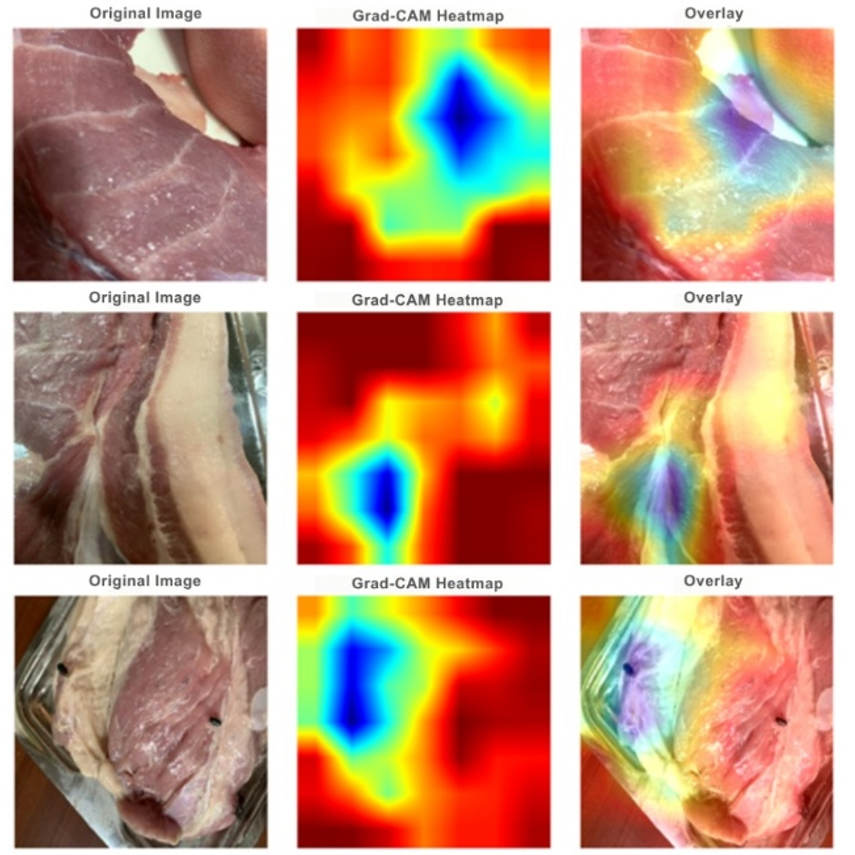
Kesegaran daging sapi merupakan faktor kritis bagi keamanan pangan di Indonesia, mengingat tingginya tingkat konsumsi dan impor komoditas ini. Metode penilaian kesegaran tradisional seringkali lambat, destruktif (merusak), atau bias secara subjektif. Penelitian ini bertujuan untuk mengembangkan model Deep Learning yang tidak hanya akurat dalam mengklasifikasikan kesegaran daging sapi (Segar, Setengah Segar, Busuk) tetapi juga dapat dijelaskan (explainable) dalam proses pengambilan keputusannya. Kami menerapkan Transfer Learning menggunakan arsitektur Convolutional Neural Network (CNN) yang ringan, yaitu MobileNetV2, pada dataset yang terdiri dari 2.266 citra daging yang telah diaugmentasi. Untuk mengatasi sifat "black-box" dari CNN, Gradient-weighted Class Activation Mapping (Grad-CAM) diimplementasikan untuk memvisualisasikan area fokus model. Hasil eksperimen menunjukkan bahwa model kami yang telah di-fine-tune mencapai akurasi validasi yang tinggi (96,01%), dengan presisi sempurna (100%) untuk kelas 'Busuk' (Spoiled), memastikan tidak ada daging busuk yang salah diklasifikasikan sebagai daging segar. Analisis Grad-CAM lebih lanjut memvalidasi bahwa model mendasarkan keputusannya pada fitur visual yang relevan secara biologis, seperti pola perubahan warna dan tekstur permukaan, bukan pada noise latar belakang. Temuan ini mengonfirmasi potensi integrasi CNN ringan dengan XAI untuk sistem kontrol kualitas yang andal, non-destruktif, dan transparan dalam industri pangan.
Keywords:
Beef Freshness, Deep Learning, Grad-CAM, MobileNetV2, XAIDownloads
References
Regita, Z., & Daspar, D. (2025). Analisis Peluang dan Tantangan Perdagangan Internasional Komoditas Peternakan antara Indonesia dan Australia dalam Kerangka APEC. Kompeten: Jurnal Ilmiah Ekonomi dan Bisnis, 4(1), 1260–1267. https://doi.org/10.57141/kompeten.v4i1.199
Brar, D. S., Singh, B., & Nanda, V. (2025). Sustainable Food Technology variety of red chilli powder †. 1099–1113. https://doi.org/10.1039/d5fb00118h
Cogswell, M., Das, A., Vedantam, R., Parikh, D., & Batra, D. (n.d.). Visual Explanations from Deep Networks via Gradient-based Localization.
Elangovan, P., Dhurairajan, V., Nath, M. K., & Yogarajah, P. (2024). applied sciences A Novel Approach for Meat Quality Assessment Using an Ensemble of Compact Convolutional Neural Networks.
Gbashi, S., & Njobeh, P. B. (2024). Enhancing Food Integrity through Artificial Intelligence and Machine Learning: A Comprehensive Review. Applied Sciences (Switzerland), 14(8). https://doi.org/10.3390/app14083421
Gilal, N. U., Al-Thelaya, K., Al-Saeed, J. K., Abdallah, M., Schneider, J., She, J., Awan, J. H., & Agus, M. (2024). Evaluating machine learning technologies for food computing from a data set perspective. Multimedia Tools and Applications, 83(11), 32041–32068. https://doi.org/10.1007/s11042-023-16513-4
Hidayatulloh, S., Mustajab, M. A., & Ramdhani, Y. (2023). Penggunaan Otimasi Atribut Dalam Peningkatan Akurasi Prediksi Deep Learning Pada Bike Sharing Demand. INFOTECH Journal, 9(1), 54–61. https://doi.org/10.31949/infotech.v9i1.4530
Jauhar, S. K., Harinath, S., Krishnaswamy, V., & Paul, S. K. (2024). Explainable artificial intelligence to improve the resilience of perishable product supply chains by leveraging customer characteristics. In Annals of Operations Research. Springer US. https://doi.org/10.1007/s10479-024-06348-z
Jayan, H., Min, W., & Guo, Z. (2025). Applications of Artificial Intelligence in Food Industry. Foods, 14(7), 1–6. https://doi.org/10.3390/foods14071241
Jian, R., Li, G., Jun, X., & Shi, G. (2025). Nondestructive freshness recognition of chicken breast meat based on deep learning. 1–19.
Kılıçarslan, S., Hız Çiçekliyurt, M. M., & Kılıçarslan, S. (2024). Fish Freshness Detection Through Artificial Intelligence Approaches: A Comprehensive Study. Turkish Journal of Agriculture - Food Science and Technology, 12(2), 290–295. https://doi.org/10.24925/turjaf.v12i2.290-295.6670
Koh, M. J., & Kim, H. S. (2025). Deep learning-based image analysis techniques for fresh meat quality prediction. 1(3), 111–124.
Lee, I. H., & Ma, L. (2025). Integrating machine learning, optical sensors, and robotics for advanced food quality assessment and food processing. Food Innovation and Advances, 4(1), 65–72. https://doi.org/10.48130/fia-0025-0007
Lin, Y., Ma, J., Sun, D., Cheng, J., & Zhou, C. (2024). Fast real-time monitoring of meat freshness based on fluorescent sensing array and deep learning : From development to deployment. 448(March). https://doi.org/10.1016/j.foodchem.2024.139078
Mostafa, S., Mondal, D., Panjvani, K., Kochian, L., & Stavness, I. (2023). Explainable deep learning in plant phenotyping. Frontiers in Artificial Intelligence, 6(2020). https://doi.org/10.3389/frai.2023.1203546
Muttaqin, I. F., & Arifudin, R. (2024). Fruit Freshness Detection Using Android-Based Transfer Learning MobileNetV2. Recursive Journal of Informatics, 2(1), 8–17. https://doi.org/10.15294/rji.v2i1.70845
Przybył, K. (2024). Explainable AI: Machine Learning Interpretation in Blackcurrant Powders. Sensors, 24(10). https://doi.org/10.3390/s24103198
Salma, S., Habib, M., Tannouche, A., & Ounejjar, Y. (2023). Revue d ’ Intelligence Artificielle Poultry Meat Classification Using MobileNetV2 Pretrained Model. 37(2), 275–280.
Sandler, M., Howard, A., Zhu, M., & Zhmoginov, A. (n.d.). MobileNetV2 : Inverted Residuals and Linear Bottlenecks. 4510–4520.
Siddique, A., Gupta, A., Sawyer, J. T., Huang, T., & Morey, A. (2025). Big data analytics in food industry : a state- of-the-art literature review Check for updates. Npj Science of Food. https://doi.org/10.1038/s41538-025-00394-y
Tan, M., & Le, Q. V. (2019). EfficientNet : Rethinking Model Scaling for Convolutional Neural Networks.
Teresa, M., Claudia, N. S., Domínguez-soberanes, J., & Alvarez-cisneros, Y. M. (2023). Heliyon Analysis of beef quality according to color changes using computer vision and white-box machine learning techniques. 9(November 2022), 0–11. https://doi.org/10.1016/j.heliyon.2023.e17976
Lima, S. A. (2024). Interpretable Fish Classification through MobileNetV2 and Grad-CAM Visualization. International Journal of Research in Engineering, Science and Management, 7(9), 93–99. https://journal.ijresm.com/index.php/ijresm/article/view/3183
Zhao, F., Wei, Z., Bai, Y., Li, C., Zhou, G., Kristiansen, K., & Wang, C. (2022). Proteomics and Metabolomics Profiling of Pork Exudate Reveals Meat Spoilage during Storage.
Zullich, M., Barbin, D. F., & Simonato, M. (n.d.). E XPLAINABLE A RTIFICIAL I NTELLIGENCE TECHNIQUES FOR INTERPRETATION OF FOOD DATASETS : A REVIEW. 1–33.
Published
How to Cite
Issue
Section
License
Copyright (c) 2025 Ade Bastian, Ardi Mardiana, Billy Adrian Fernanda, Harun Sujadi, Abrar Wahid, Riri Nurazizah, Wildan Zhilal Manafi

This work is licensed under a Creative Commons Attribution-ShareAlike 4.0 International License.