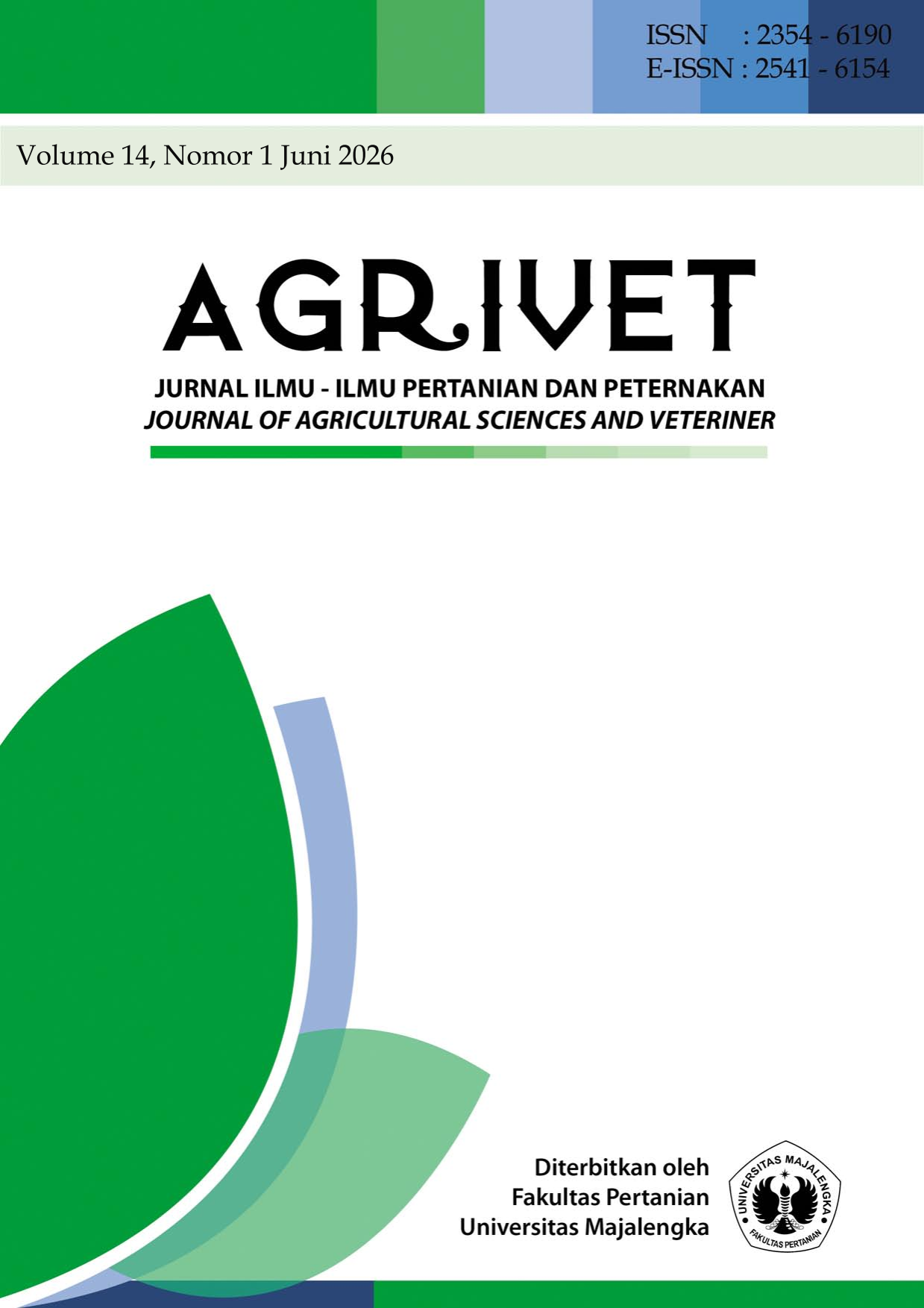
The use of digital applications in horse farm management in jeneponto regency
DOI:
https://doi.org/10.31949/agrivet.v14i1.17814Abstract
Digital transformation in the livestock sector is one of the efforts to improve business management efficiency and expand market access for farmers. However, the utilization of digital technology in rural areas still faces various obstacles, particularly regarding infrastructure, digital literacy, and human resource readiness. This study aims to assess the level of digital application adoption among horse farmers and identify factors influencing its utilization in the management of horse farms in Tolo Timur Village, Kelara Subdistrict, Jeneponto Regency. This study employs a qualitative approach supported by descriptive quantitative data, with data collection techniques including interviews, questionnaires, observations, and a literature review, involving 30 horse farmers selected using simple random sampling. Data were analyzed descriptively using a Likert scale to measure farmers' perceptions regarding several indicators: internet availability, ease of application use, application utilization in livestock business management, and interest in participating in digital training. The results of the study indicate that only half of the farmers (50%) own a smartphone, and the utilization of digital applications in livestock business management remains relatively low. The main challenges include limited digital literacy, limited experience with technology, and the perception that digital applications remain difficult to use in livestock business activities. Nevertheless, some farmers expressed an interest in participating in training on the use of digital applications. Therefore, support is needed in the form of improved digital literacy, training and mentoring for farmers, and the development of simple, user-friendly applications to enable the optimal use of digital technology in the livestock sector.
Keywords:
technology adoption, digital applications, horse farming, digital literacy, livestock business managementDownloads
References
Andaruisworo, S. (2022). Karakteristik Peternak Sapi Potong di Kecamatan Badas Kabupaten Kediri Pasca Pandemi.
Banda, L. J., & Tanganyika, J. (2021). Livestock provide more than food in smallholder production systems of developing countries. Animal Frontiers, 11(2), 7–14. https://doi.org/10.1093/af/vfab001
Bhardwaj, P. (2019). Types of sampling in research. Journal of the Practice of Cardiovascular Sciences, 5(3), 157. https://doi.org/10.4103/jpcs.jpcs_62_19
Choirinisa, A. A. (2022). PENGARUH PENGGUNAAN APLIKASI DIGITAL TERHADAP EFEKTIVITAS KERJA PEGAWAI. Transekonomika: Akuntansi, Bisnis Dan Keuangan, 2(5), 483–492. https://doi.org/10.55047/transekonomika.v2i5.239
Davis, F. D. (1989). Perceived Usefulness, Perceived Ease of Use, and User Acceptance of Information Technology. MIS Quarterly, 13(3), 319–340. https://doi.org/10.2307/249008
Eisfeldt, A. L., & Papanikolaou, D. (2013). Organization Capital and the Cross‐Section of Expected Returns. The Journal of Finance, 68(4), 1365–1406. https://doi.org/10.1111/jofi.12034
Gabriel, A., & Gandorfer, M. (2023). Adoption of digital technologies in agriculture—an inventory in a european small-scale farming region. Precision Agriculture, 24(1), 68–91. https://doi.org/10.1007/s11119-022-09931-1
Groher, T., Heitkämper, K., & Umstätter, C. (2020). Digital technology adoption in livestock production with a special focus on ruminant farming. Animal, 14(11), 2404–2413. https://doi.org/10.1017/S1751731120001391
Hilbert, M. (2016). The bad news is that the digital access divide is here to stay: Domestically installed bandwidths among 172 countries for 1986–2014. Telecommunications Policy, 40(6), 567–581. https://doi.org/10.1016/j.telpol.2016.01.006
Klerkx, L., Jakku, E., & Labarthe, P. (2019). A review of social science on digital agriculture, smart farming and agriculture 4.0: New contributions and a future research agenda. NJAS: Wageningen Journal of Life Sciences, 90–91(1), 1–16. https://doi.org/10.1016/j.njas.2019.100315
Koswara, A., & Manajemen, M. (2024). Digitalisasi ekonomi di pedesaan: Mengkaji kesenjangan infrastruktur digital di Indonesia. Jurnal Al Azhar Indonesia Seri Ilmu Sosial, 5(3), 180–187.
Rose, D. C., Wheeler, R., Winter, M., Lobley, M., & Chivers, C.-A. (2021). Agriculture 4.0: Making it work for people, production, and the planet. Land Use Policy, 100, 104933. https://doi.org/10.1016/j.landusepol.2020.104933
Rotz, S., Gravely, E., Mosby, I., Duncan, E., Finnis, E., Horgan, M., LeBlanc, J., Martin, R., Neufeld, H. T., Nixon, A., Pant, L., Shalla, V., & Fraser, E. (2019). Automated pastures and the digital divide: How agricultural technologies are shaping labour and rural communities. Journal of Rural Studies, 68, 112–122. https://doi.org/10.1016/j.jrurstud.2019.01.023
Salemink, K., Strijker, D., & Bosworth, G. (2017). Rural development in the digital age: A systematic literature review on unequal ICT availability, adoption, and use in rural areas. Journal of Rural Studies, 54, 360–371. https://doi.org/10.1016/j.jrurstud.2015.09.001
Sulistyo, W. (2025). Peran Peternakan Digital dalam Mendukung Efisiensi Produksi Ternak. Jurnal Riset Rumpun Ilmu Hewani, 4(1), 108–115.
Wolfert, S., Ge, L., Verdouw, C., & Bogaardt, M.-J. (2017). Big Data in Smart Farming – A review. Agricultural Systems, 153, 69–80. https://doi.org/10.1016/j.agsy.2017.01.023
Published
How to Cite
Issue
Section
License
Copyright (c) 2026 Nurul Magfirah Ashar, Andi Nur Syahbani

This work is licensed under a Creative Commons Attribution-ShareAlike 4.0 International License.
An author who publishes in the Jurnal Agrivet agrees to the following terms:
- Author retains the copyright and grants the journal the right of first publication of the work simultaneously licensed under the Creative Commons Attribution-ShareAlike 4.0 License that allows others to share the work with an acknowledgment of the work's authorship and initial publication in this journal
- The author is able to enter into separate, additional contractual arrangements for the non-exclusive distribution of the journal's published version of the work (e.g., post it to an institutional repository or publish it in a book) with the acknowledgment of its initial publication in this journal.
- The author is permitted and encouraged to post his/her work online (e.g., in institutional repositories or on their website) prior to and during the submission process, as it can lead to productive exchanges, as well as earlier and greater citation of the published work